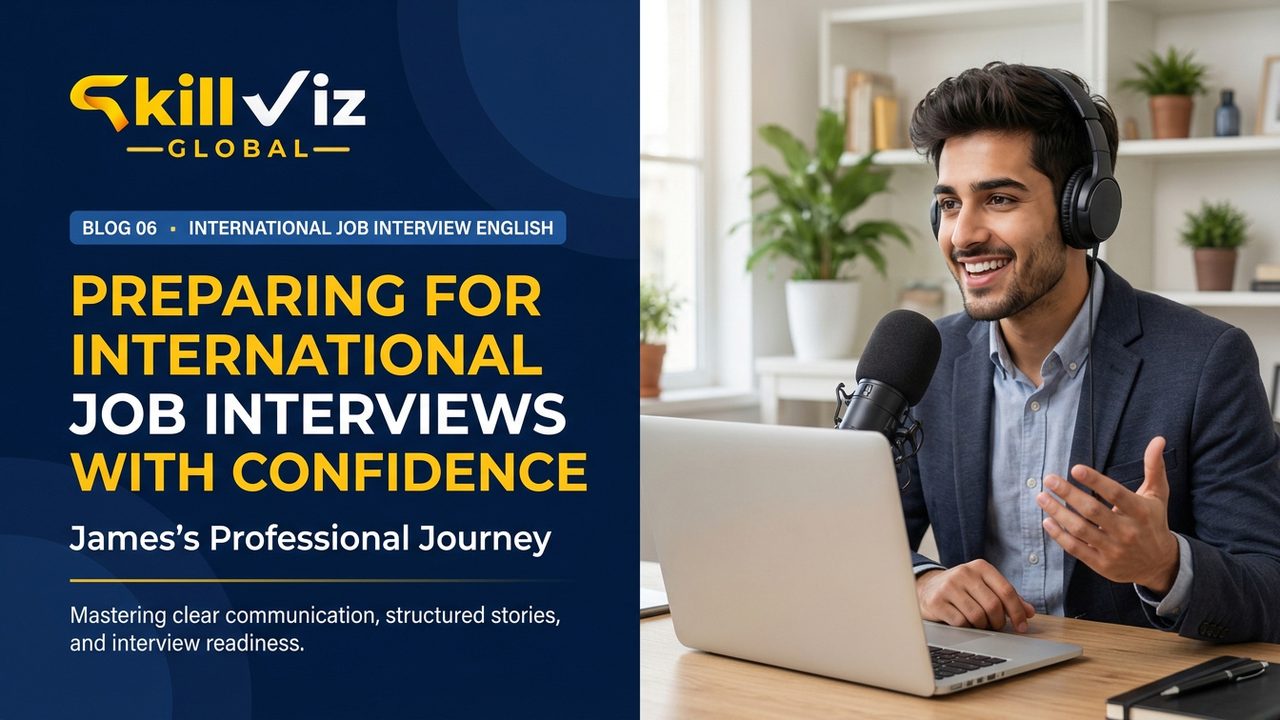
These articles are illustrative stories with fictional characters. They are not testimonials or claims about actual SkillViz Global learners.
“You don’t need a perfect script. You need clear, honest stories you can tell with confidence.”
James had the experience and qualifications for international roles, but interviews in English made him nervous. He worried about unfamiliar questions, losing his words and sounding less confident than he felt. Instead of memorising long answers, he prepared to communicate his experience clearly.
Understand What Interviewers Are Asking
James reviewed the job description and identified the skills and examples that matched it. He practised listening for the purpose of each question—experience, problem-solving, teamwork or motivation—rather than memorising a script.
Prepare Concise Stories
He used a simple structure for examples: situation, action and result. For each key skill, he prepared a real example and kept the details clear. He never exaggerated or invented achievements.
Practise Common Questions
James rehearsed answers to “Tell me about yourself,” “Why are you interested in this role?” and “Describe a challenge you handled.” He practised aloud, aiming for natural, organised answers rather than perfect wording.
Handle Difficult Moments
He learned phrases that gave him time and clarity: “Let me think for a moment,” “Could you clarify the question?” and “I haven’t faced that exact situation, but I would approach it by…”. These helped him stay composed without pretending to know everything.
Present Yourself Professionally
For online interviews, he checked his camera, lighting, background and internet connection. He prepared questions for the interviewer and reviewed his CV so he could discuss every detail accurately.
Build a Practice Checklist
- Review the role and the job description.
- Prepare real examples using situation, action and result.
- Practise aloud.
- Test your equipment.
- Plan your questions for the interviewer.
- After each mock interview, note one strength and one improvement.
Key Takeaways
- Listen for the purpose behind each question.
- Prepare honest, concise stories.
- Keep a few phrases ready for difficult moments.
- Practise aloud and review each session.
- Test your setup before an online interview.
Interview confidence comes from preparation and practice. Clear, honest answers, active listening and a calm recovery when you stumble can help you show what you know.